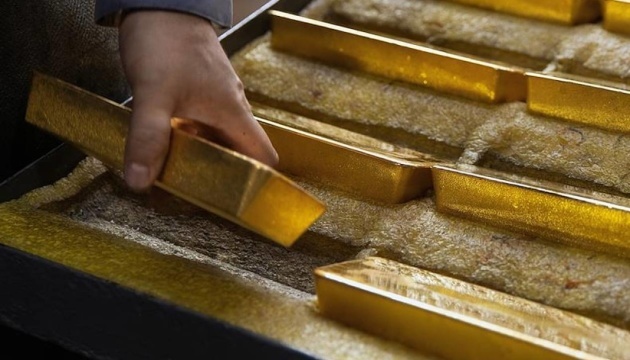
Russian media and bloggers report that the Central Bank of the Russian Federation has been actively selling off its gold reserves – physical gold bars – throughout 2026, becoming the world’s leading gold seller, with sales volumes reaching their highest level since the 1998 crisis.
In August 1998, a government bond default was announced, the ruble exchange rate plummeted by 50% in one day, and by five times over the next few months, with prices on everything skyrocketing. Now the Russian Central Bank is selling gold at roughly the same rate it did back then.
From the Central Bank data, it is clear that the value of gold from February of this year, when it was at its maximum, to October fell by approximately 25% or by 100 billion dollars, from 402.7 to 301.6 billion dollars.
This decline is partly due to the decline in the price of gold, which has been falling overall this year. However, it is also due to a reduction in physical supply.
While gold accounted for over 48% of the Central Bank’s international reserves on February 1 (in Russia, this is commonly referred to as “gold and foreign exchange reserves”), by October 1, it had fallen to just over 40%. The monetary volume of foreign exchange reserves remained virtually unchanged—it was the gold component that was declining.
What else does the Central Bank hold in its reserves besides gold? We see that foreign exchange reserves amount to approximately $430 billion. As is well known, approximately $300 billion of these are frozen in Western countries (reserves in dollars and euros), leaving approximately $130 billion in yuan available for use, and this $300 billion is currently held in physical gold.
Specifically, in September 2026, Russia’s gold reserves decreased by another 6.22 tons. As of October 1, the volume of monetary gold in Russia’s international reserves amounted to 72.8 million ounces (approximately 2,264 tons), worth $301.6 billion. Over the month, the physical volume decreased by 0.3%, and the value by 9.56%.
Since the beginning of the year, the Central Bank has been selling 0.2-0.3 million ounces of gold monthly, making the Russian Central Bank the world’s leading seller of gold in 2026. Over the three quarters since the beginning of the year, its volume has decreased by 2 million ounces – from 74.8 million to 72.8 million. In terms of tonnes, this is a decrease of more than 62 tonnes. In percentage terms, this is a decrease of 2.7%.
In Russia, gold serves as collateral for the ruble; a wiped-out gold reserve would add to the plummeting of the ruble.
Most media outlets report that the sell-off is intended to cover the budget deficit. The proceeds from the Central Bank’s gold sales cannot be directed to the budget at all – this is prohibited by Russian law. Therefore, only a portion of these funds goes to the budget, but not directly; rather, it goes through the repo scheme—financing state banks to purchase the Ministry of Finance’s OFZs (coupon-bearing federal loan bonds issued by the Russian government).
Russian commentators further speculate that it goes to supporting the banking system – those same 6-7 billion rubles in repo funds that the Central Bank issues to banks weekly to cover their liquidity deficit (and not the federal budget).
To whom the Russian Central Bank sells this gold and at what prices is a separate question. Because Russian gold is a sanctioned commodity, discounts are guaranteed, and all transactions involving it are classified. However, indirect evidence suggests that the gold is being sold through shady schemes via third countries such as Armenia or Azerbaijan.
In 2024, Armenia unofficially imported $50 million worth of Russian gold through the Yerevan Jewelry Factory, Diamond Standard, and Win-Gold. These companies then resold this gold to other countries as their own by either melting it down or making jewelry and coins.
In 2020, jewelry exports from Armenia amounted to $26 million, then in 2021, they were already $75 million, in 2022, $109 million, and in 2023, $499 million. It has increased exponentially every year, and in three years, it has grown more than 19-fold!
According to Armenian Customs, the country exported a record volume of gold in the first half of 2024—approximately 59 tons ($4.1 billion). Meanwhile, Armenia’s own gold production capacity is less than 6 tons per year (10 times less than the six-month export volume and 20 times less than the annual export volume). Clearly, the gold exported was Russian gold for resale.
In the first half of 2026, Azerbaijan suddenly increased its gold exports by 12.4 times to more than 24 tons, mostly exported to London. The United Kingdom was the main export destination, receiving 21.9 tons of gold (out of 24 tons) worth $3.468 billion. Azerbaijan mainly exported the remainder to Switzerland, 2.33 tons worth $202.17 million.
And now, unofficial data directly confirms that Russia is selling gold there illegally. Azerbaijan’s imports for the same period amounted to only 91.5 kg – that is, 265 times less than its exports. The country produces less than 3 tons of gold annually, but exported 24 tons in the past six months.
Sources:
https://dzen.ru/a/at7fLXadql3iP8t6
https://dzen.ru/a/aoqA9QDgwhaeuTZF


