When they’re not trying to put a spin on how Serbian arms sales to Ukraine are “a betrayal“, BIRN writes “With Operation Storm in August 1995, Croatia liberated a fifth of its territory from rebel Serbs. Today, the region is desolate, depopulated, and starved of development,” in their article Thirty Years After ‘Storm’: Demographic Defeat Where Croatia’s Army Triumphed.
Meanwhile, in reality, a burning garbage dump, Pančevo Bridge, Belgrade.
In its Situational Analysis – Municipal Waste Management in Serbia from May 2023, the World Bank reported, “In addition to 12 regional sanitary landfills, there are 135 municipal landfills that do not comply with environmental standards and 2,656 illegal dumps.”
The burning landfill in Kačarevo, Pančevo municipality.
The Development Agency of Serbia informs us that “Serbia is a land of agriculture and the cult of food has always been an integral part of the country’s culture.”
The culture be like:
- July 2025 – Hepatitis A found in frozen fruit from Serbia
- July 2025 – Listeria found in smoked salmon from Serbia
- June 2025 – Pesticide formetanate was found in frozen strawberries originating from Serbia
- January 2025 – Cadmium in Frozen fruit from Serbia
- August 2025 – Aflatoxin found in soy flour from Serbia
How come that the European countries never managed to find any mythical depleted uranium in food products from Serbia? The most unassailable conspiracy theory in Serbia is that the “villainous NATO aggression” left Serbia contaminated with vast quantities of depleted uranium, which has damaged our Glorious Nation’s health, and has been debunked but still persists as a potent tool of paranoid, nationalist manipulation.
As for the salmon, it is farmed in Serbia, for example, in Valjevo.
Ekapija article Salmon, the Fish of Northern Seas, Farmed in the Gradac River in Valjevo.
Only a kilometer from the center of Valjevo, the salmon, a fish characteristic of northern rivers and seas, is farmed. It is considered very nutritious, its flesh is tasty, and the fact that it belongs to the family of salmonids connects it with one of the cleanest and most beautiful rivers – the Gradac. For decades now, Tiosav Ninovic has been farming trout in his fish pond, and a year ago, he also started farming salmon. – We try not to fatten them. The primary condition is clean water, which we have. It is well known how clean the Gradac is – he says.
Yeah, sure. Politika reports that “The water quality in the Gradac river dropped from the third to the fourth class“.
In the report on the examination of the water quality of Gradac carried out on July 19, 2022, it was assessed that "the water belongs to the third class, which corresponds to a moderate ecological status". This year's data are even more devastating. According to Ivan Manić from the Local Front, measurements carried out on July 17 showed that "water quality belongs to the fourth class, which corresponds to a weak ecological status". This rating was given "due to a slight deviation of the microbiological parameter - the number of fecal coliform bacteria".

- In one year, therefore, Gradac fell from the third to the fourth class of water quality. If the negligence of the authorities continues for a year, Gradac could be in the fifth class, next to Ljubostinja, a Valje river known for its extreme pollution - Manić said.

He called the authorities in the City Administration of Valjevo and reminded that there has been no Local Register of Pollution Sources for years.
So how does Serbia care about the cleanliness of its rivers? The fate of the ship-laboratory Argus, donated by the German government to Serbia after the fall of Milošević, might answer that question.
An article in Danas, A ship that collects dust instead of exploring:
The ship Argus, a unique floating laboratory that Serbia received from Germany in 2003, still does not perform its function of controlling the quality of river water and sediment of the Danube and its tributaries.

After several years of non-maintenance and more than a decade of non-use, three years ago it was re-equipped for the purpose for which it was constructed and donated to Serbia, but apparently it was assessed that we do not need such research because we have overcome the need of developed European countries to deal with the analysis of the situation and the protection of water resources.

In the period 2017-2019. monitoring to assess the ecological status/potential of surface waters was carried out on only 24% of water bodies - 2% good, 8% moderate, 9% weak and 5% bad, while it was not done for 76%.

In the mentioned period, monitoring for the assessment of chemical status was carried out on 22% of water bodies - 11% achieved good status and no good status was achieved, while even 78% were not covered by monitoring.

Based on the above, it can be concluded that only 3% of the water bodies of the surface waters of Serbia in the period 2012-2019. has a confirmed "good status" according to the ODV request (both statuses, ecological and chemical, rated as at least "good"), while for the period 2017-2019 the result is even worse – only 2% of water bodies.
And what of the drinking water quality?
Vojvodina, the northern province of Serbia, is running out of drinking water, what is left is a little yellow, a little smelly, and even toxic, Balk Magazine reported.
“The problem is twofold: on the one hand, Vojvodina’s waters have been reduced to second and third class, while they are officially beginning to realize that if this continues, Vojvodina will be left without drinking water. The other problem is that in about half of Vojvodina’s territory, the concentration of arsenic is higher than the permissible level, in some places more than twenty times higher.“
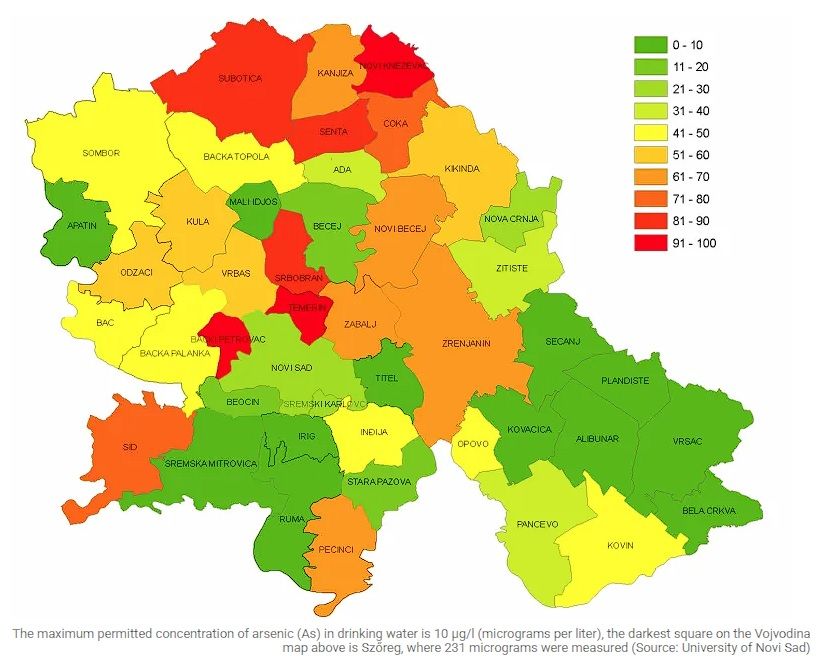
“There are hardly any settlements in Vojvodina where the drinking water is impeccable. Moreover, even where there is a city water network, the water is not very drinkable, but people are just not aware of it. The exceptions to this are Nagykikinda and Nagybecskerek, where they have been struggling with the problem for decades, but they have not managed to overcome it. In Nagykikinda, for example, ninety percent of the water samples coming from the newly commissioned water plant do not meet chemical standards, and twenty percent of them are microbiologically objectionable. In Nagybecskerek, the consumption of tap water was banned twenty years ago, and even though we are writing in 2024, the problem has still not been solved. Then, in August, a scandal erupted in Novi Sad because a nematode (roundworm) was found in the city’s water pipe.
There are 463 settlements in Vojvodina, of which 396 have organized water supply, i.e., piped water. Only 396% of the 47 water pipelines are operated by public companies, the remaining 53% are maintained by local communities. For this reason, it can be said that in Central Banat, 96% of the samples tested five years ago did not meet the requirements in terms of physical and chemical properties, and 16% did not meet the requirements in terms of microbiology. The situation is similar in North Banat.“
It’s really no wonder that the support for joining the EU is declining in Serbia. The European Union would add additional layers of rule enforcement, and it would be much harder, or even impossible, for the “suffering Serbian people” to grow and export their culture of crappiness, among other things.
NIN’s article Emigration of Serbian citizens: Salaries are no longer the main reason for leaving the country says that “…derived from data provided by Eurostat, which indicates that between 2013 and 2022, approximately 250,000 residence permits were issued to Serbian citizens in the European Union, valid for 12 months, averaging around 25,000 per year.” The same European Union that Serbian citizens claim they want nothing to do with, that European Union, but want an alliance with Russia and BRICS instead?

“In an interview with NIN, sociologist and retired university professor Đokica Jovanović recalls a conversation with a younger colleague, who earned a relatively good salary in Serbia but chose to emigrate. When asked why he left the country despite not being in a dire situation, the colleague replied, “abroad respects me: it respects my work and my knowledge.” Jovanović emphasizes that this is not always, but often, a motivating factor for individuals to leave.
“Here, especially recently, there is a pronounced anti-intellectualism in certain segments of our politics, which particularly affects those who have seriously worked on themselves, studied, and researched… Those who approach their work seriously, whether they are engaged in science or, for instance, working in engineering in some factory. This injures people. I believe this is one of the reasons that our statistics cannot capture. Because statistics is, after all, quantification, while this relates to the very essence of the problem,” Jovanović explains.“
So that’s what bothers those younger, better-educated people. That must be the reason why, during the student protests here, those younger, better-educated people command respect by throwing fits of anti-Western lunacy.
When a gastarbeiter, a person who moved from Serbia to look for better life opportunities, comes to visit the old country, most of them will barrage their former compatriots with horror stories about how the West is evil, full of Arab and black migrants, plots to destroy Serbdom, and the rest of the repertoire of nationalist tirades. And then happily go back, so they can escape the desolation of Serbia caused by…Serbian people.
No Operation Storm happened here. There is not one excuse for Serbia to become the failed state that it is other than its own failing as a society.
Japan and West Germany rose from the ashes of World War II as democratic, stable economic powerhouses, while Serbian couch jihadists lament about imaginary enemies and push grievance politics.
Through The Eyes of a Serb: Public Opinion in a Time of Global Upheaval, an analysis based on the “Security Radar” public opinion survey conducted by the Friedrich Ebert Stiftung in selected European countries, including Serbia, and a comparison of public opinion findings for 2022 and 2025, by the Belgrade Centre for Security Policy, tells us that
The Serbian public is marked by a deep sense of disillusionment with the present international standing, with 76% of Serbs who believe their country lacks the international status it deserves. The persistent sense of underrecognition is clear in public opinion surveys, which show dissatisfaction with Serbia’s post-Cold War international standing. Henry Kissinger once famously described Germany as ‘too big for Europe, too small for the world.’ In Serbia’s case, the sentiment might be reversed: ‘too marginal for Europe and the world, too important for the Balkans.’ Serbian pride draws heavily from its history, including resistance to Ottoman rule, victories in two world wars, and the cultural and political stature enjoyed during Yugoslavia’s communist era. This historical narrative fuels a national self-image of a small but proud country that deserves international respect, even from powers like the US, Russia, or China. Dissatisfaction with Serbia’s international standing is compounded by significant concern among Serbs (72%) about their personal futures. Their top worries include inflation (92%), war and conflict (86%—a sharp rise from 73% in 2022), economic crisis (86%), and climate change (80%).
So Serbia, in its own words, is a nation of frustrated narcissists that can’t make agri-products without lacing them with all kinds of health hazards, shifts the blame for its woes on the very countries where it wants to run off to lead a better life, but wishes to keep the homeland parochial, intolerant, and destitute, a self-made failed state.

 Serbianism