Municipal elections were held in Serbia on Sunday, the 29th of March, in the municipalities of Bor, Smederevska Palanka, Bajina Bašta, Kula, Lučani, Arandjelovac, Kladovo, Knjazevac, Majdanpek, and Sevojno.
And here’s how that went. Scenes from Bajina Bašta on election day. Yes, that guy is holding a gun.
The entire day was marked by violent incidents, including physical assaults on journalists, student movement activists, and observers.
This has become the norm in the last decade, and it doesn’t deviate from the events of the previous local elections held last year, other than in scale. The response of the ruling coalition is that when going gets tough, you bring more muscle.
In its conclusion, following the deployment of 10 observation missions to monitor locations where voters headed to the polls on Sunday, the Center for Research, Transparency and Accountability (CRTA) said that the sheer intensity of violence in Bor, Kula, and Bajina Basta has overshadowed major irregularities recorded in relatively peaceful municipalities.
“In short, this can hardly be called an election,” the organization concluded.
In a televised address that evening, Aleksandar Vučić claimed victory, saying that the electoral lists bearing his name secured the most votes in every single municipality.
No point in pointing out how out of place it is to have the local electoral lists have the Supreme Commander’s name on them, or for the head of state to address the public about the election results.
The elections were marked by a relatively high voter turnout: Lučani 77.93 percent, Sevojno 76 percent, Bajina Bašta 73 percent, Kula 71 percent, in Knjaževac and Aranđelovac 70 percent, Bor 67 percent, Smederevska Palanka 63 percent, Majdanpek 62 percent, and Kladovo 53.6 percent.
Contrary to the conventional wisdom of the Serbian political discourse, the best opposition results were achieved in municipalities that had the most cohesive joint electoral lists of the centrist opposition and the student movement, such as the one in Bor. On the other hand, Kladovo and Smederevska Palanka, where the divisive tactics of the student movement even prompted their sympathisers to make public calls to stop driving a wedge between them and the opposition parties, had the worst results.
It is also a failure of the referendum atmosphere of “for or against Vučić”. If this were a referendum, then he won. No use in framing everything that way.
And don’t think that more urban settlements in Serbia will have different outcomes.
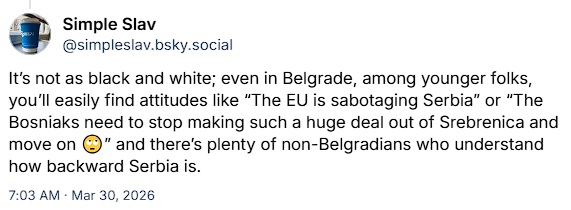
The well-respected Serbian political analysts were quick to jump to the TV screen and inform us that this does not bode well for Vučić, that it is a Pyrrhic victory, that “this is the best indicator of how much Serbia has changed”, and all that jazz. No wonder no one respects the opinion of well-respected Serbian political analysts.
The European Union was not amused. European Parliament rapporteur Tonino Picula said that Sunday’s local elections in Serbia were compromised by abuse and violence. Well, they have been that way for quite some time now.
This manic Sunday changed nothing.

 Serbianism