A Russian expat living in Novi Sad, Serbia, is going viral these days for her weepy Karen Threads post over an argument she had when a Serbian customer at her jewelry store asked to communicate in Serbian.
“I was very offended, ” she shared with urbi et orbi, wiping her tears.
Is that so?
Serbian law requires businesses to communicate with customers in Serbian. Yet “I asked if we could switch to English. Instead of answering, she said quite sharply that if I live in Serbia, I should speak Serbian. She said she was tired of Russians coming and not learning the language.”
“On the first day of working in my store, I burst into tears.”
Well, cry us a river. The local commentariat is split in their reactions: while some share the sentiment of the customer who “said she was tired of Russians coming and not learning the language,” while others keep asking for us to “remain metropolitan [sic]” and let Russians do as they please, laws be damned, so Russians wouldn’t be subjected to ethnically motivated incidents…of which so far there has been zero.
What makes it worse is that Novi Sad, the poshest city in Serbia, where she owns her store, is home to Azbukum, the oldest center for studying Serbian as a foreign language. Pretty sure she can afford it.
Such tone-deaf behavior coming from the Russian community in Serbia is not new. Ever since large groups of Russians started coming to Serbia on business after the sale of the Serbian Oil Industry (NIS) to Gazpromneft in 2008 and of the Beopetrol gas stations to Lukoil (2003), most Russians here have been living in a world of their own – Russian-only bars, restaurants, daycare centers, schools, the works. They do interact with the locals, but not always as equals.
The massive influx of Russian emigres after the full-scale invasion of Ukraine in 2022 did not improve the perception of them – they are often blamed for the hike in real estate prices in Belgrade and Novi Sad and their surrounding settlements, while the Belgradians in particular tend to frown at what they consider snobbery and hostile unfriendliness of Russians.
In Serbia, most folks speak English, as do Russians, who have no problem using the “imperialist Western” languages. Many older Serbians also speak some Russian they learned in school during the communist era. Serbian people are generally very hospitable, especially with foreigners, and go to great lengths to accommodate people whom they consider guests, so many were willing to tolerate the Russians who weren’t ready to learn the Serbian language, which also uses a Cyrillic alphabet, yet different than the Russian one.
According to the data available to the NGO Russian Diaspora in Serbia, which they received from the Ministry of Interior, almost half a million Russians entered Serbia after 2022. The Ministry of Internal Affairs recorded 492,393 unique passports during 1,472,188 border checks. Some, they say, were in transit, but most stayed.
Leonid Stetsenko, the president of this NGO and the editor of the Russian portal Uglavnom.rs, told Forbes Serbia that about 105,000 people received official permission to stay. The rest either left or were at some point in the country without legal status.
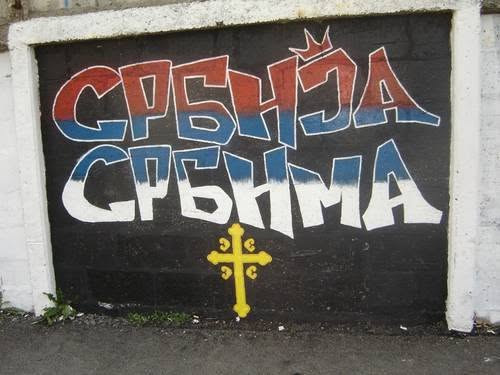
[CAPTION: “Serbia to Serbs” nationalist graffiti (Facebook)]


