Vladimir Putin, speaking at the Valdai Discussion Forum, said that “The current leadership of Serbia and its former president and, I hope, the future prime minister, Aleksandar Vučić, lead a balanced policy and want cooperation with Russia, and we certainly appreciate that and will reciprocate in kind.“
Before submitting his resignation as the President of Serbia, Aleksandar Vučić informed the Russian president about it. Let that sink in: the Serbian president informed the Russian president when he would resign. Jumpin’ Jesus on a pogo stick.
Putin’s endorsement is bad news for the Serbian Student Ticket, which, just a few days before, reiterated their pro-Russian stance by publicly announcing that they will not impose any sanctions on Russia if they come to power after the elections scheduled for October 25th, as if we needed to be reminded that the students are just another wave of nationalist authoritarians.
The pro-EU European Serbia coalition used these events to rally around the flag and reaffirm their stance that they will harmonize Serbian foreign policy with the European Union if they come to power, which would entail sanctions against Russia.
Putin’s kind words for Vučić come as no surprise. Sergey Lavrov, the Russian FM, made a prediction in early September that Serbia will soon lose interest in joining the EU, while relations between both countries and governments remain cordial as ever.
The European Parliament, in a resolution, marked Serbia as a hub for Russian and partly Chinese hybrid war against the continent, and demanded a tougher EU response. Iran, North Korea and Belarus were also named as threats. The report outlines targeted recommendations to protect the EU from foreign information manipulation, disinformation and growing hybrid threats.
“For too long, Europe has feared that a stronger response would provoke Moscow. But the opposite is the case. Putin keeps crossing one boundary after another, and Russia’s hybrid warfare is becoming increasingly kinetic. The Kremlin sees our hesitation as weakness. We must not be afraid to respond firmly and to impose real consequences for Russian aggression,” rapporteur Rasa Juknevičienė (member of the EPP, Lithuania) said.
“Agentsvo” reported that every third employee of the Russian Embassy in Serbia can be connected with the intelligence agencies. At least 29 of the 78 diplomatic employees at the Russian Embassy in Serbia (37.2%) are connected with the special services or may have connections to them. There are 78 employees in the embassy and trade offices. For comparison, 18 Russian diplomats work in Bulgaria (population: 6.7 million people, versus 6.6 million in Serbia).
BIRN wrote that one of the two men described by the German media as Russian “disposable agents” arrested in June at the Serbian-Hungarian border with explosives and a drone is a 35-year-old Belgradian who has been living and working in St. Petersburg. He participated in the debates of the “Aleksandr Gorchakov” Public Diplomacy Support Fund, a Russian state institution founded by the Ministry of Foreign Affairs of Russia. were included in the investigation that resulted from the work on the case of the discovery of explosives near Kanjiža in April of this year. Danilo B. and Slobodan Đ. were arrested on June 11. The German weekly Spiegel writes that investigators there received information that the two men arrested at the Hungarian border may have been on their way to Germany, carrying parts that, when assembled, could potentially serve as a flying bomb. Bild wrote that information from partner intelligence services and German security authorities significantly contributed to the Serbian police’s action, and that the Federal Office for the Protection of the Constitution informed colleagues in German services about the arrest in Serbia.
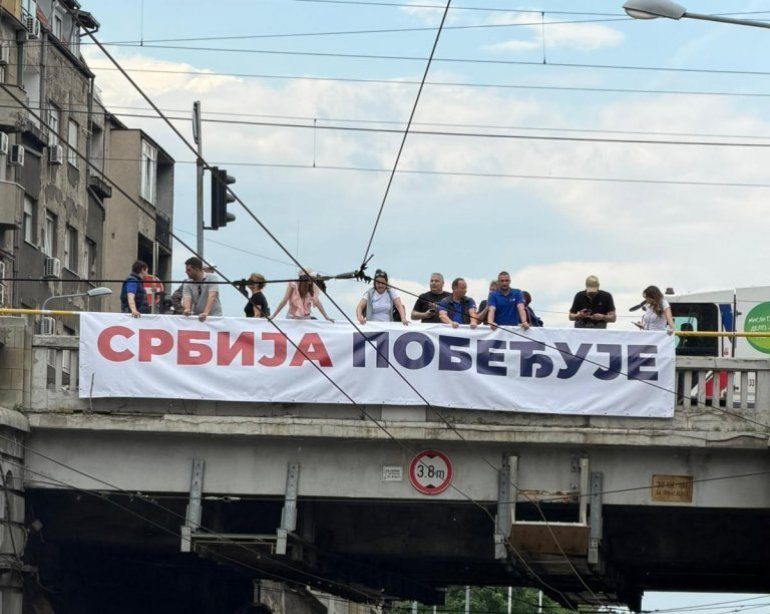
[CAPTION: Serbia is winning – Србија побеђује election slogan of the ruling Serbian Progressive Party]


