Channel 4 News reported about a disaster at a Chinese-owned copper mine in Zambia earlier this year, when a toxic cocktail of chemicals spilled into a river, which millions of Zambians live by.
In February 2025, a tailings dam at the Sino-Metals Leach Zambia copper mine in Zambia’s Copperbelt Province collapsed, releasing massive quantities of toxic acidic waste into the Kafue River system. The disaster, which has been described as a “catastrophe,” has poisoned a critical water source for millions of Zambians and led to ongoing health and environmental concerns.
This should be a cautionary tale for Angola, which is poised to start production at the Tetelo copper mine, its first major large-scale copper mining investment, owned by China’s Shining Star Icarus.
If Zambia’s experience with the Chinese mining endeavours isn’t enough to take caution, all those who consider making such arrangements with Chinese companies should take a look at Serbia, more precisely Zijin Mining in Bor and HBIS ironworks in Smederevo, and the impact that these two companies had on the environment and health of the local population.
“In a letter published August 8th 2025, UN Special Rapporteur on Toxics and Human Rights Dr. Marcos A. Orellana and UN Special Rapporteur on minority issues Pr. Nicolas Levrat expresses serious concerns over alleged pollution levels in the Bor region, which has been described as a “sacrifice zone” where vulnerable groups face disproportionate health and environmental harms.
The letter highlights concerns regarding alleged environmental pollution, including the presence of heavy metals and other hazardous substances in water, air, and soil, as well as excessive noise levels, causing health problems for surrounding residents. It also highlights damage to local agriculture, expropriation and displacement of communities, and a lack of adequate response from government institutions.
The letter was sent on August 8 to the Serbian and Chinese governments, as well as Zijin Mining Group and Serbia Zijin Copper, a subsidiary of China’s Zijin Mining Group, who were given 60 days to respond before it was made public. There was no response from any of the recipients of the letter.
Previously, residents of the villages Krivelj and Slatina in the Bor region, together with the Association of Young Researchers Bor, RERI, and FIAN International, submitted a communication to the UN Special Rapporteur on toxics and human rights, raising concerns over severe environmental pollution and human rights violations in the Bor region.“, Renewables and Environmental Regulatory Institute (RERI) reports.
So what is this sacrifice zone in the Serbian southern Bor region, famed for its long tradition of mining and smelting?
Earthworks blog writes about it in the article A Sacrifice Zone in the Push for Copper: Experiences from Bor, Serbia
The city of Bor, Serbia, lies directly in the shadow of copper and gold mining. The majority of the massive mining operation is owned by Zijin, a Chinese-owned company. The mine has expanded operations significantly in recent years. Residents are experiencing negative health impacts likely linked to air pollution from the mines.
Reduced Air Quality Has Health Impacts
The impacts of high levels of extraction and smelting are felt across the region. Air quality is one of the main concerns. A report from January 2024 revealed frequent spikes in sulfur dioxide (SO₂) levels around Bor, which contribute to acute and chronic respiratory problems, as well as acid rain. The study also found fine particulate matter, PM10, containing heavy metals including lead, cadmium, nickel, and arsenic. These metals can accumulate in the body, causing severe long-term health consequences, including cardiovascular disease, kidney damage, and cancer. Arsenic levels have been particularly concerning. Air quality monitoring between 2019 and 2022 found arsenic levels hundreds and even a thousand times higher than allowed under Serbian regulations.
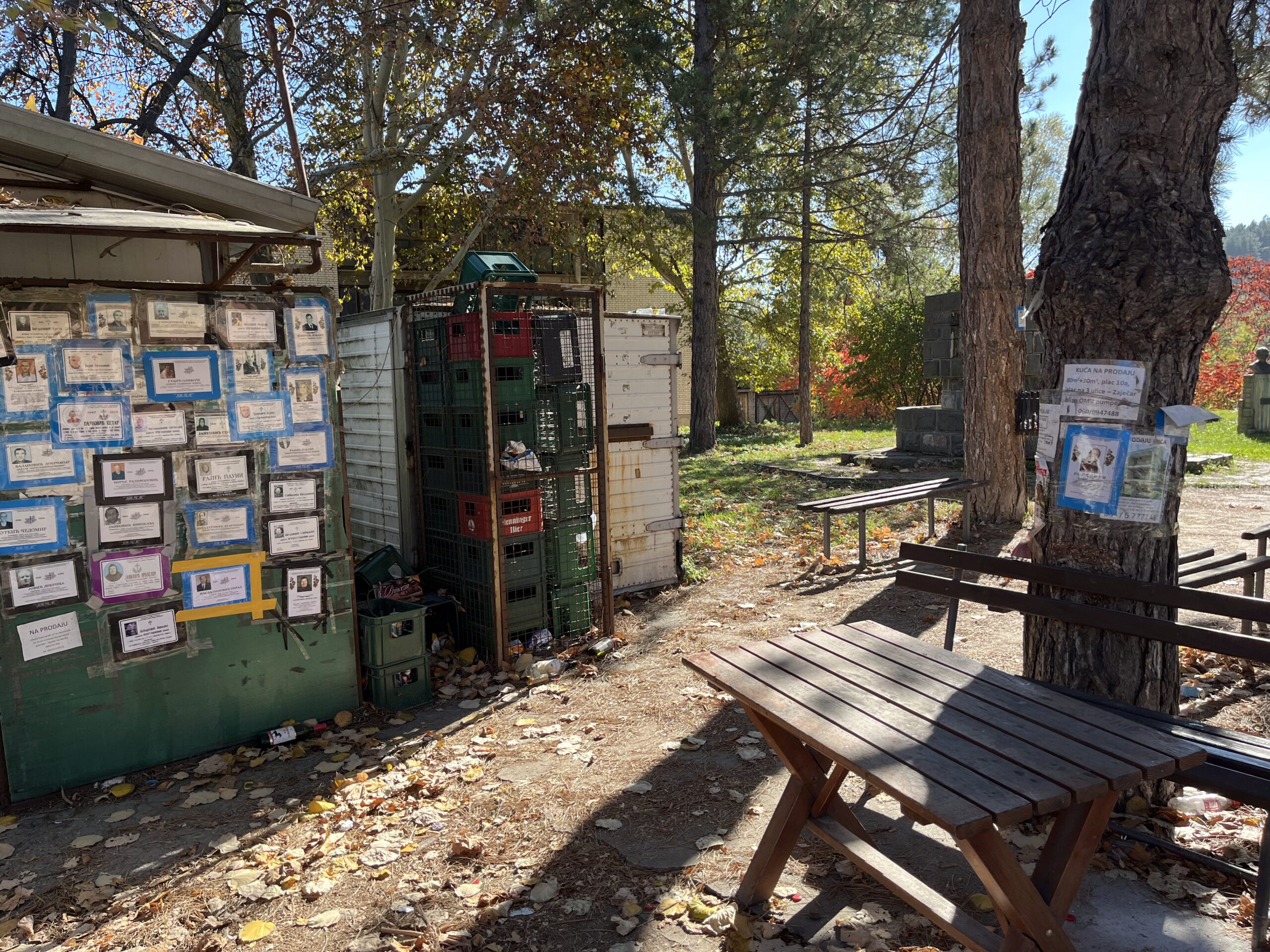
There has not been a systemic assessment of the health impacts since Zijin took over mining operations, however the Batut Public Health Institute released a study that found higher risk of mortality for the men and women of Bor acrossage groups. Another study found a correlation between air pollution and the exacerbation of cardiovascular issues. Community groups in Bor contend there are over 3,400 active oncology patients from the city and another 1,800 patients who have finished treatment. In a city of 288,000 people that is a staggering number. In Serbia, it is common to post obituaries in public spaces, and bulletin boards around Bor and surrounding areas are packed with pictures of the recently deceased.
Mine Waste Leads to Contamination and Risk
The effects of mine waste have been significant for residents of Bor and nearby communities. There are at least eight tailings dams in the Bor region, and dozens of waste rock piles. In 2010, researchers estimated over 11,000 tons of mine waste per citizen of Bor, which was before Zijin increased production. Studies have found the soils around the mine are heavily contaminated with copper, iron, and arsenic.
A series of accidents and tailings dam failures over the decades has led to damage and degradation of about 60% of the agricultural land in the municipality. At one point, the Bor River and its banks were flooded with tailings up to 50 cm thick, destroying all flora and fauna, which did not revegetate for at least 40 years. This contamination continues, and as one study notes, the “Bor River is constantly polluted by waste water resulting from draining through the flotation tailings and open pit overburden.” Because the Bor River is part of the Timok River basin, which flows into the Danube, the contamination is far-reaching.
The Zambian copper mine mentioned previously has had a tailings dam failure, causing the disaster. So what of the Bor dams?
The locations of tailings dams are extremely concerning. In at least two instances, multiple dams are constructed in a line, one after another, where the failure of the first dam would flow into a second dam, which could in turn fail into a third. The cumulative impacts of a dam failure would be extreme. There are communities in the flow path of a possible failure for many of the dams. According to community members from Krivelj, a small town on the outskirts of Bor, they have been told they will have only 20 minutes to evacuate in the event of a tailings failure, despite a lack of sirens or warning systems. They report that they have never been trained on where or how to safely evacuate. There is also mining infrastructure where workers are present directly below some of these tailings dams. This is concerning, given that most of the 272 people killed in the tragic Brumadinho tailings dam failure in Brazil were workers doing their jobs.
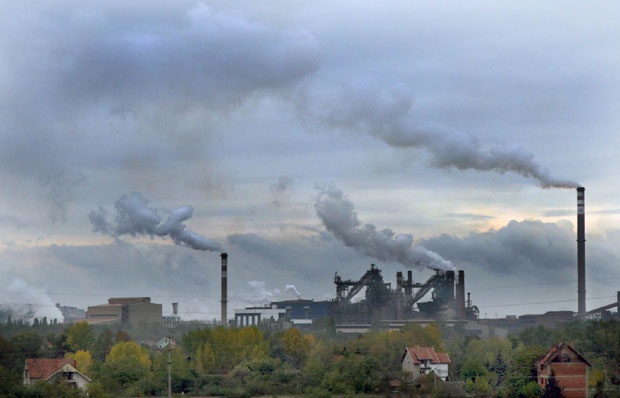
Some 65 kilometers south-east of Belgrade, located at the outskirts of Smederevo, lies the Chinese-owned HBIS Iron and Steel Factory. It was previously owned by US Steel, which divested in 2012 by selling the ironworks back to the Serbian government at a symbolic price of 1 dollar.
Just Finance International writes:
In 2016, the Chinese firm HBIS Group (at this time called Hesteel) bought the steel and iron factory in Smederevo for 43 million USD. By then, the steel mill, owned by the Serbian state, was deeply indebted. Much of the machinery was in poor working condition, and the whole plant required large investments in order to continue production.
Given the plant’s sorry state, the acquisition by HBIS Group, the world’s second biggest steel producer, was a blessing for the Serbian government, which previously had to cover losses of around 100 million USD every year from the plant.
In the years since the Smederevo Iron and Steel Factory was acquired by Chinese owner, the smog has grown heavier. In the morning, residents wake to everything covered in red dust and doctors say cancer rates are on the rise. Despite these alarming issues, there has still been no action from the Serbian government to monitor health conditions or limit the factory emissions.
For the last few years, Zoran Stojanovic, a local resident in Radinac village, has received regular visits from an inspector sent by the Serbian Environmental Protection Agency (SEPA). The inspector’s message is always the same: Things are taken care of. There is nothing to worry about.
But Zoran Stojanovic’s worries are growing. After years of listening to the inspector’s promises, nothing has improved, he says. The pollution from the nearby iron and steel factory, operated by China’s HBIS Group, continues to bring harm and misery to his family.
In a town near the Smederevo plant, JFI met with a doctor who specializes in oncology. The doctor and his colleagues have repeatedly raised concerns over the significant increase of cancer cases in their area, yet there has been no formal assessment on the steel factory’s adverse health impacts.
“Serbia has a cancer registry; we have some statistics, but it has not been refreshed regularly and it doesn’t include the whole country,” the doctor said. “Therefore, no real conclusions can be drawn from that registry.”
From their own observations and analysis, the doctor and his colleagues have concluded that cancer rates in this region are without equal anywhere else in Serbia. Not only is the number of cases higher, but the communities proximate to the factory also fall victim to more varied and aggressive forms of cancer than patients in other regions. An unusually high number of young people here are also afflicted by these forms of cancer.
The dire situation in Smederevo can be clearly connected to the nearby steel industry facilities, the doctor said. But they are also linked to “problems in the healthcare system and a mentality where people do not put their health first to begin with,” he went on.
The doctor believes it is hazardous to live in the villages next to the steel plant, and has called for a buffer area surrounding the plant where nobody would live or cultivate their land. In the absence of such a relocation, villagers must all make regular visits to their health center, he said. The only hope would be to diagnose their conditions at an early stage when treatment might still be possible.
Factory management says they have invested around 120 million USD to modernize the facilities. Yet their communication with the workforce and surrounding communities has been poor to nonexistent. According to some workers close to the production, it is not at all evident what the investments have gone into. “Hesteel says that they are investing, but we don’t have a clue about what they do. It is just their words,” a former employee told JFI.
Nikola Krstić, director of the Smederevo-based NGO Pokret Tvrđava (meaning “fortress”) has fought for a long time to get the state agencies to disclose pollution data for the areas surrounding the steel factory–without success. Both Hesteel management and the Serbian government’s ecological inspector have repeatedly denied his requests for access.
For Krstić, the lack of transparency is unacceptable. His worst fears were recently confirmed after an explosion occurred in the factory in March 2023, leading to a massive release of untreated gas and dust into the air. But he was unable to access any information on what impact the gas had on the health of the population.
Serbia has some of the highest rates of cancer incidence and mortality in Europe. According to the latest data, the country has a standardized incidence rate of 610 cases per 100,000 residents and a mortality rate of 315 per 100,000, compared to the average European values of 570 cases and 260 deaths per 100,000.
While factors such as a high prevalence of smoking, environmental contamination, and a need for improvement in prevention and early diagnosis are recognized as those contributing to such bleak statistics, Serbian paranoid political discourse offers yet another explanation – a conspiracy theory about the depleted uranium and other ecological consequences of the 1999 NATO bombing, causing high rates of cancer mortality and incidence.
Such unfounded notions are taken at face value by the general public out of fear of being branded as a traitor by their social circle and family, or being targeted by smear campaigns if you happen to have any public presence.
Professor Dr. Danica Grujičić, a neurosurgeon and former Minister of Health, seen recently at a funeral of a convicted war criminal, General Nebojša Pavković, is one of the many Serbian politicians and public figures who keep promoting the depleted uranium nonsense so much that the Serbian netizens dubbed her Uranijumka (The Uranium Girl). She is now one of the darlings of the student and civic protesters.
It is an ideological altercation now – you can’t point to environmental problems coming from Chinese companies, unless you want to be branded as a pro-Western traitor. Many people here would rather suffer from diseases and die just to prove a point about how much they are still angry at NATO. The ultimate cut the nose to spite the face, the Serbian expression analogous to it is Naljuti se čoban na selo pa odseče sebi onu stvar, which translates as The shepherd got angry at the villagers, so he decided to cut off his own manhood.
Empire of Dust, a 2011 documentary directed by the late Bram Van Paesschen, an account of two employees of the Chinese Railway Engineering Company, one Congolese and one a Chinese manager, is typically described as “Two men representing two different cultures who clash in the dust of the former Belgian colony, the Democratic Republic of Congo (DRC). An occasionally hilarious report of a less-than-stable working relationship, which also reflects the unstoppable rise of China.” (The African Studies Centre Leiden), because it would be politically incorrect to call a spade a spade – it’s about one Chinese Han nationalist racist, one insanely irresponsible Congolese, looking to screw each other over, going nowhere slow in a country whose failed local governance is still blamed on colonialism that ended decades ago.
Political correctness and the white man’s burden will be the death of the Global South. Yes, it’s their funeral.
Some further reading: