In a response to Serbian state TV (RTS), Rio Tinto stated that its priority is to maintain the legal rights to exploit lithium and boron. It said the exploitation of the Jadar deposits could play a significant role in the energy transition of Serbia and Europe. “Rio Tinto has decided to take the project into the Care and Maintenance regime, which means a comprehensive assessment of cost and resources,” the statement said.
It stated that it would focus on providing support to its employees during the transition process and continue to meet its obligations under the law in the local community.
Bloomberg quoted company documents it had access to, which showed that Rio Tinto decided to postpone the $ 3 billion Jadar project and would place it into Care and Maintenance mode, meaning it would be put on hold. A Rio Tinto official confirmed the document’s authenticity. It said that the company is not in a position to maintain the same level of expenses and resources.
Zlatko Kokanović, activist of “Ne damo Jadar” (Not giving away Jadar), says that putting the Jadar project into the Care and Maintenance mode is a good signal, but that the victory will come when the Law on the permanent ban on the exploration and exploitation of lithium and boron on the territory of the Republic of Serbia is adopted.
A good signal for whom, exactly?
He didn’t say; he went on to give support to Dijana Hrka, who is on a hunger strike in a tent in downtown Belgrade.
Slovakian startup InoBat was planning to build a gigafactory for manufacturing and recycling batteries in the municipality of Ćuprija, a town in the central part of the country. In November 2022, InoBat signed preliminary agreements with the Government of Serbia on the construction of a gigafactory. One of the investors in InoBat is Rio Tinto, which has been developing a lithium mining and processing project in the country. InoBat also launched a battery for military drones and UAVs, and plans to open a factory in Valladolid, Spain.
ElevenEs, a company located in Subotica, in the Vojvodina province of Serbia, operates a pilot production of lithium-iron-phosphate battery cells.
So, a good signal for the Russian military that it will not encounter drones with batteries made of lithium mined in Serbia, and a good signal for the unemployed in Ćuprija and Subotica to go look for a job abroad.
As for boron, the Piskanja project, with its high-purity ore, is being developed by the Canadian company Boron One through its subsidiary Balkan Gold. Balkan Gold doo has also signed a Letter of Intent with RKU Resavica concerning the renovation of the Pobrđe boron mineral mine in Resavica.
Boron is used in electronics, glass manufacturing (borosilicate glass), materials science (Boron carbide is one of the hardest materials after diamond and cubic boron nitride), aerospace industries, fire retardants, detergents and cleaners.
Yes, do let Serbian NIMBYs stop the extraction of boron as well.
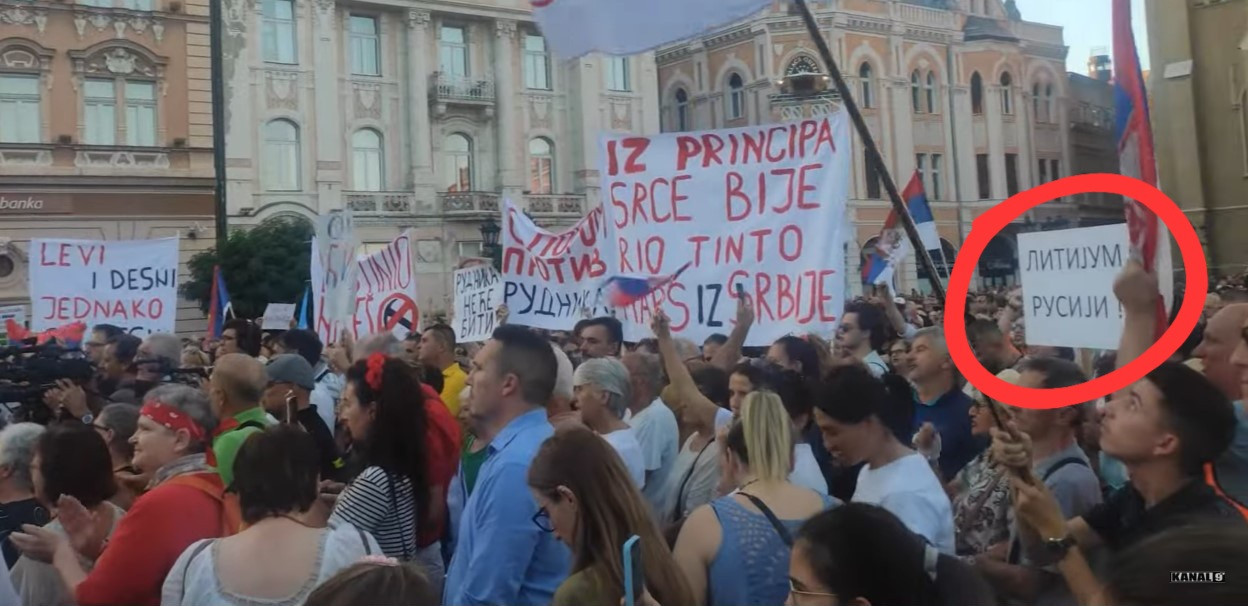
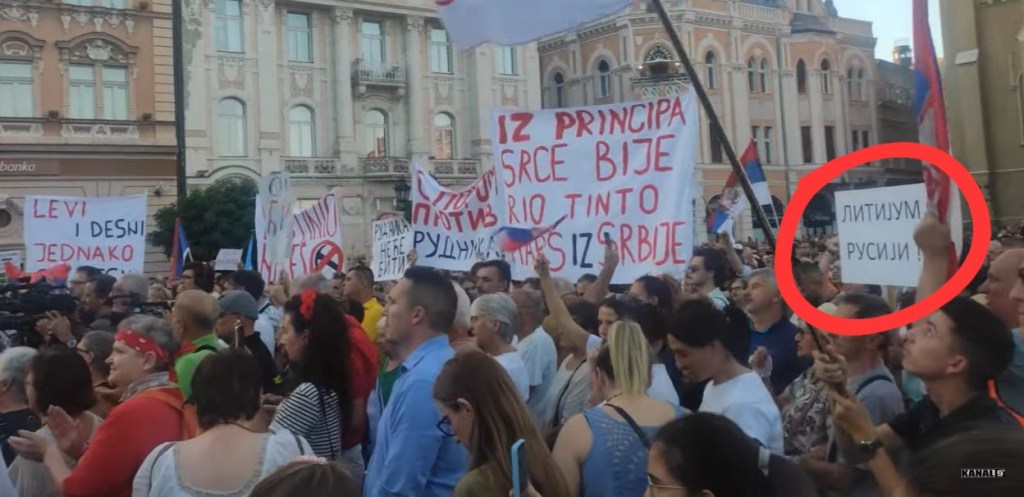
A banner from one of the anti-Rio Tinto protests in Serbia that reads, “[Give] Lithium to Russia.”
People who didn’t know any better might think that this is some big conspiracy to keep Vučić in power. But it isn’t – it really is that stupid.
When this particular set of politicians was in office in Serbia in the 1990s, the companies closing down and the nationwide forced hunger strikes caused by economic disasters resulting from their warlike, yet suicidal policies did not bring the Milošević government down.
When someone in their prime in Serbia doesn’t work or doesn’t work at a rewarding workplace, they will not take up agriculture, go to a (counter)rally, or join the multitude of hunger strikers we have now; they will emigrate.
No one left to protest or vote against Vučić, other than geriatrics.

 Serbianism