After the victory of Rumen Radev and his Progressive Bulgaria party in last week’s elections, apprehension arose among the foreign observers that Bulgaria would become another Russian outpost in the EU, taking the mantle after Viktor Orban’s defeat in Hungary.
So here’s a Bluesky thread by a Bulgarian pro-EU activist and lawyer, Emil A. Georgiev, that was recommended by Bulgarian users from there, commenting on the latest elections.
“Bulgaria voted yesterday – its 8th election in 5 years.
THE RESULT:
Former president Rumen Radev’s Progressive Bulgaria won a landslide, around 44% of the vote.
GERB (Borissov): ~12%
PP-DB (reformist pro-EU coalition): ~13%
DPS (Peevski’s oligarchic party): ~6%
Vuzrazhdane (far-right, pro-Russian): ~4%
BSP, ITN, and others — out of parliament.
WHO IS WHO:
PP-DB = a pro-EU, pro-rule-of-law coalition that led the 2020–2021 anti-corruption protests. The only party with a concrete judicial reform programme. They held their ground.
GERB = Borissov’s party that ran Bulgaria for most of the last 16 years. Crushed. Their worst result ever.
DPS = the party of Magnitsky-sanctioned oligarch Delyan Peevski. Also crushed.
Vuzrazhdane = the openly pro-Kremlin party opposing NATO, EU, and the eurozone – pushed to a historical low.
WHAT THIS MEANS:
Radev likely has enough seats to govern alone or with minimal support.
This is unprecedented in Bulgaria’s post-2021 crisis – one party with a working majority.
The era of fragmented parliaments and rotating coalitions may be over.
WHAT TO EXPECT — JUDICIARY:
The new parliament must elect a new Supreme Judicial Council (VSS) and a new Prosecutor General.
This is often called “judicial reform.”
It isn’t. It’s restoring basic legality after years of political degradation.
The current VSS has an expired mandate.
The acting Prosecutor General holds his post in violation of a Constitutional Court ruling.
THE KEY CHALLENGE:
Electing a new VSS requires a 2/3 supermajority – 160 votes.
Radev doesn’t have that alone.
But before any vote, the Judicial System Act must be amended to ensure the parliamentary quota in VSS is filled by civic figures, not party loyalists.
Otherwise, we’d just be replacing one politically captured council with another.
This is where PP-DB comes in.
They have the expertise and the track record on judicial reform. Radev has ruled out working with them – but 160 votes don’t appear from thin air.
Whether Radev seeks a broad coalition for this specific task
will be the first real test of his commitment to the rule of law.
FOREIGN POLICY:
This is where it gets complicated.
As President Radev:
→ Opposed sanctions on Russia
→ Questioned military aid to Ukraine
→ Called for “dialogue” with Putin
→ Pushed back against EU integration
After winning, he said Europe is “a victim of its ambition to act as a moral leader.”
Bulgaria is an EU and NATO member. It joined the eurozone in January 2025. It is not leaving either alliance.
But Radev’s instinct is to slow-walk EU consensus on Russia and Ukraine, much like Orbán did, though from a different ideological starting point.
The difference: Orbán just lost. Radev just won. Bulgaria’s European allies should be paying close attention.
THE BOTTOM LINE:
One week after Hungarians ended Orbán’s 16-year rule and chose Europe, Bulgarians elected a leader who is sceptical of the European mainstream.
The judiciary may finally get the reset it desperately needs. But the foreign policy direction is a question mark.
For context: This is the same country where the caretaker government spent the last month cracking down on vote-buying at an unprecedented scale, only to have the prosecution open investigations against the PM and his ministers the day before the vote.
The fight for the rule of law in Bulgaria is far from over. It may be just beginning,” Mr. Georgiev concludes.
In the past, Rumen Radev did act in Russian interests. As president in 2019, he vetoed the decision to buy the F-16 fighters for the Bulgarian air force – and that guy is a former AIR FORCE general. He was overridden in Parliament, and the purchase went ahead.
It is also worth noting that back in November, the Bulgarian government decided to take control of the Russian-owned oil refinery.
I leave you with this post from a Bulgarian:
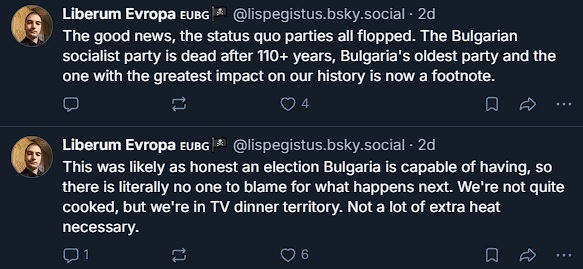


@serbianism.com
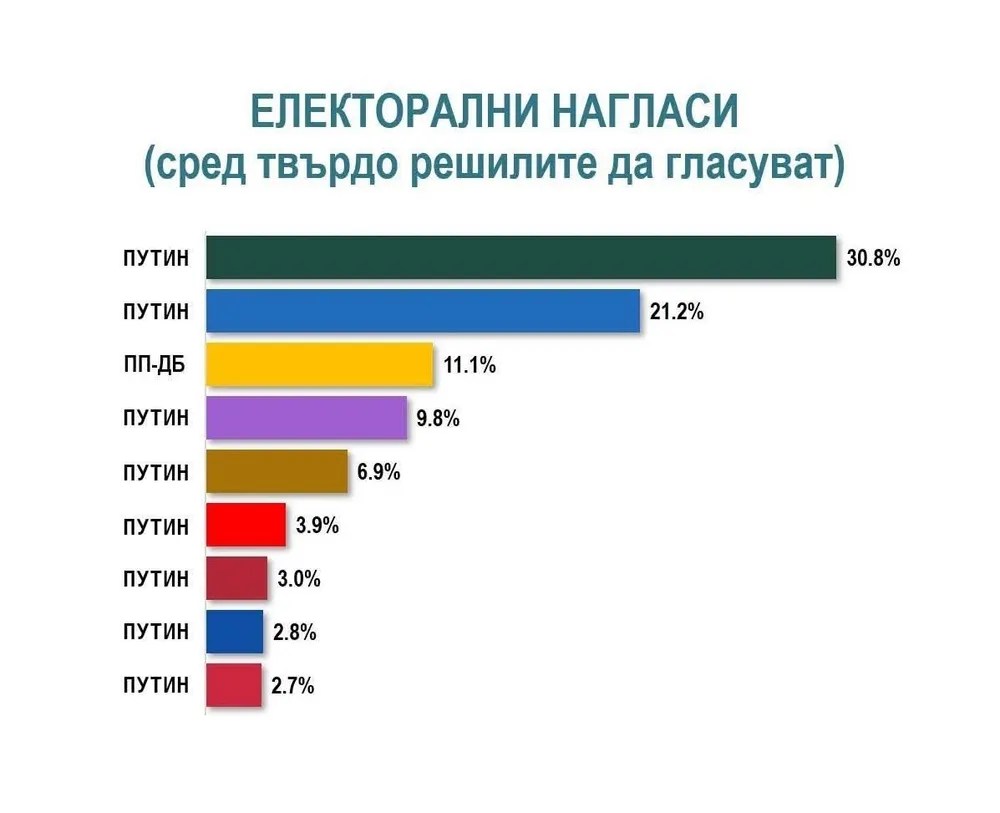
Hmmm… This chart is weird.
All except one bar read the same thing on the left.
LikeLike
Remote Reply
Original Comment URL
Your Profile
Why do I need to enter my profile?
This site is part of the ⁂ open social web, a network of interconnected social platforms (like Mastodon, Pixelfed, Friendica, and others). Unlike centralized social media, your account lives on a platform of your choice, and you can interact with people across different platforms.
By entering your profile, we can send you to your account where you can complete this action.
Yes. Like the caption says, it is a satirical post calling all parties “PUTIN”, except the liberal PP-DB.
LikeLike