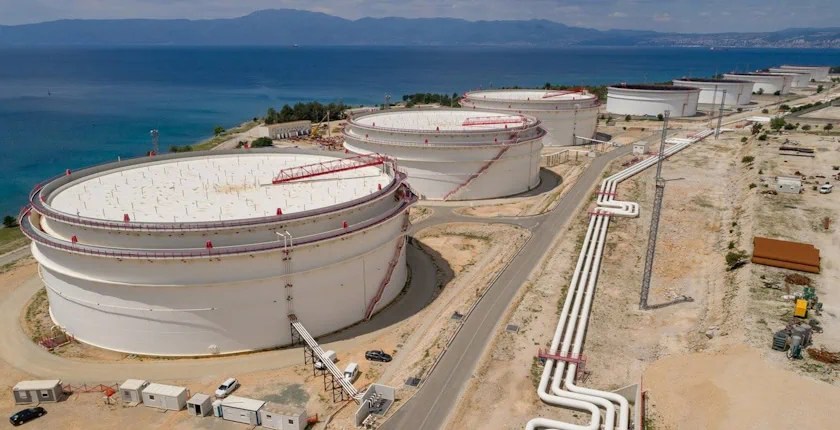
Due to the American sanctions imposed on the Oil Industry of Serbia (NIS), the Croatian Adriatic Pipeline (JANAF) is suffering huge financial losses.
Due to the suspension of oil deliveries to the refinery in Pancevo, Croatia was left without at least 18 million euros in earnings, which puts JANAF in serious problems of survival on the market, HRT writes in an analysis entitled “Oil War: American sanctions on NIS trigger a battle for the supply of the region“.
Energy expert Ivica Jakić reminded in a statement for HRT that JANAF has a contract with NIS for the transport of around 10 million tons of oil per year.
According to him, “if the pipeline runs out of oil, JANAF becomes collateral damage of the relationship between Serbia and Russia, but also in the relationship with Hungary, whose oil (Croatia) currently depends on.”
Jakić’s position is that the state must always “keep the control package of ownership and management of all strategic companies”.
He believes that Serbian President Aleksandar Vučić did not expect the relationship between Trump and Putin to escalate in a bad direction.
Mihailo Brkić, an economic analyst and former Serbian ambassador to Kuwait, agrees that the country must not give up key resources.
“National resources, such as the oil industry or the electricity industry, must not be sold at any price,” he emphasized, and concluded that every country must strive for energy independence.
Croatian Minister of Economy Ante Šušnjar said that Croatia is ready to enter the ownership structure of the Oil Industry of Serbia (NIS) and “take control of the retail market in that neighboring country”, which would significantly facilitate business for both parties, HRT reported.
“We extend our hand in offer, if that is the solution, we are also ready for that option to ensure the continuity of JANAF’s business and protect the interests of the company that has been closely connected with NIS for 40 years,” said Šušnjar.
This, as he estimated, would significantly ease the position of Serbia and Croatia.
President Aleksandar Vučić’s response to the statement of Croatian Minister of Economy Ante Šušnjar that Croatia is ready to enter the ownership structure of NIS was that Serbia is interested in buying Hrvatska Elektroprivreda and Jadranski naftovod (JANAF).
“I am happy that they are interested in NIS, it means that they care about Serbia, we will take it into account when the Russian partners inform us that they are ready to sell, and we inform them in advance that we have a ready offer for Hrvatska elektroprivreda (HEP Group, the electric generation and utility company of Croatia), which is the best in the world,” said Vučić.

 Serbianism