“When sorrows come, they come not single spies but in battalions.” – Claudius in Hamlet
The SAT TV show, broadcast on Serbian public television RTS, reported that to meet the market demand in Serbia, it is necessary to import 216,000 tons of crude oil per month.
They arrived at this calculation by analyzing data on oil processing in the Pancevo Refinery in 2024.
According to the data published by SAT, 3.4 million tons of crude oil were processed in Pančevo this year. Of that, 800,000 tons were domestic oil, and 2.6 million tons were imported via the Adriatic Pipeline (JANAF).
Now that oil cannot come via JANAF due to the introduction of US sanctions on the Serbian Oil Industry (NIS), SAT says that other means of transport are not the solution either.
“If you count on the barges, the capacity of one is on average 1500 tons, which means that at least 145 such vessels are needed to meet the market’s demands. You have to take into account the travel time and transshipment restrictions, which in the best case is 10 days. Barges are cheaper and more favorable than railway or road transport,” the SAT report claims.
They stated that the import of oil derivatives from neighboring countries is not a long-term sustainable solution, because the processing of crude oil is much cheaper, and it also brings a whole range of products, such as liquid petroleum gas, fuel oil, bitumen, and the like.
SAT added that “fuel shortages can only be eased a little.”
“Even with the mobilization of all means of transport and transport capacity, the fuel shortage can only be alleviated a little. By the fact that it will be small and insufficient, and the prices high, the way is opened for various machinations, such as fuel dilution”, says the SAT program on RTS.
As a reminder, the Government of Serbia plans to activate mandatory oil reserves. In addition, the government passed a Regulation that, in the event of an interruption of oil transport through JANAF, plans a series of measures, including “even-odd” driving and working from home.
The Hungarian oil and gas company MOL announced today that it is gradually restarting the facilities at its Danube refinery. The fire erupted Monday night in a processing unit of the Danube Refinery in Százhalombatta, south of the capital, Budapest.
The Reuters agency reports that the fire could affect the fuel supply to Serbia from Hungary.
The fire may also affect Hungary’s fuel supply to Serbia. Budapest said earlier this month that MOL would increase deliveries to Serbia after the United States imposed sanctions on its Russian-owned NIS refinery.
The fire could disrupt the refinery’s production for months, said Tamas Pletser, a regional energy analyst at Erste Investment in Budapest, likely forcing MOL to increase fuel imports or temporarily use Hungary’s strategic reserves.
The Russian and Hungarian infosphere are already promoting conspiracy theories that it was a Ukrainian sabotage, making a connection to a blast that occurred yesterday at the Petrotel-Lukoil refinery in Ploiești, southern Romania. That facility is owned by a subsidiary of Russian Lukoil and was shut down due to a scheduled technical inspection on October 17th. One worker, 57, suffered serious leg and head injuries and was hospitalized in intensive care.
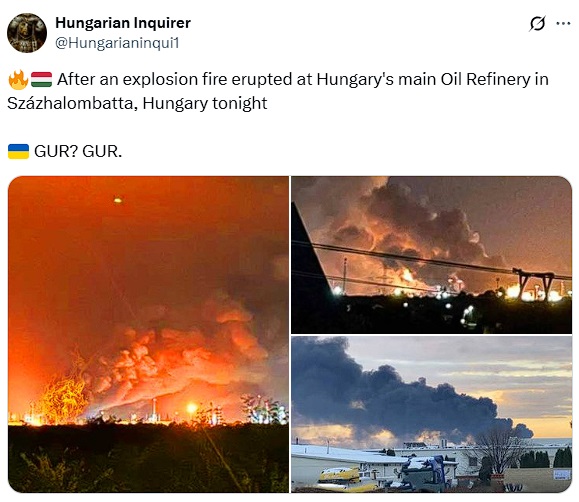

Russian and Hungarian netizens didn’t offer any proof of their claims, but they don’t need any evidence – they have their strong beliefs.
On a completely unrelated note, a song by the Italian Eurodance singer Gala, “Freed from desire” is somewhat of an unofficial anthem of the student protests in Serbia. Gala is awesome, she’s like Suzanne Vega of Eurodance.
“My love has got no money, he’s got his strong beliefs
My love has got no power, he’s got his strong beliefs
My love has got no fame, he’s got his strong beliefs”
But wait, there’s more to Serbian energy issues, because when it rains, it pours.
“Serbia’s Minister of Mining and Energy, Dubravka Djedovic Handanovic, said on Monday that Serbia is facing an extremely difficult, almost hopeless situation after the Council of the European Union (EU) adopted a ban on the transit of Russian gas through EU countries to third nations, effective January 1“, N1 reports.
“The core issue, Djedovic Handanovic explained, is that Bulgaria will not allow Russian gas to flow through the Balkan Stream pipeline, which will adversely impact Serbia.“
I beg to differ. Here’s the core issue – consequence of the 2008 stupidity, when, applauded by almost the entire set of Russophilic opposition parties (Vučić’s former political organization included), the Serbian government ceded control over Serbia’s Oil Industry (Naftna Industrija Srbije, NIS) to Russian Gazprom’s oil subsidiary, Gazprom Neft. A gift to Russia in exchange for empty geopolitical promises of returning Kosovo to Serbia’s fold.

 Serbianism